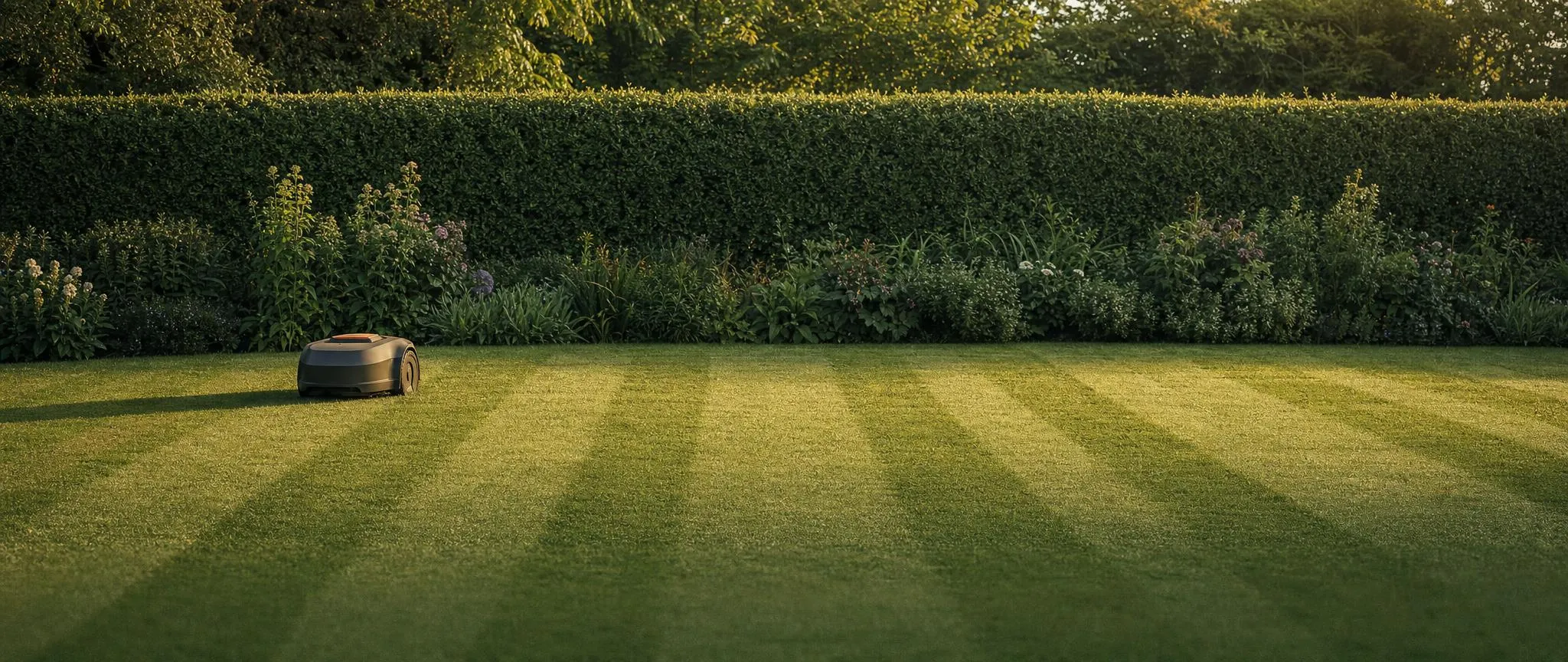

- Cuts up to 0.62 acres2,500 m², for one of the lowest prices you will find
- Spots things in its path and drives around them
- Cuts the grass to any height from 1.2 in30 mm to 3.5 in90 mm
- The pole you mount outside needs a clear view of the sky
- No phone signal of its own, so you can only check on it from home
- If someone steals it, there is no way to see where it went
The brand's numbers
- How it knows where to go
- Satellites and a camera. No wire to lay.
- Biggest lawn it can keep cut
- 0.62 acres2,500 m²
- Steepest hill it can climb
- 50% — a rise of 50 ft per 100 ft (about 27°)
- Cutting width
- 33 cm (13 in)
- Cut height
- 30–90 mm (1.2–3.5 in)
- Can remember more than one lawn
- Yes
- How it gets around things in its way
- Camera, a sensor that measures how far away things are, a bumper it nudges things with
- No boundary wire to lay
- Yes
- Needs open sky over the lawn
- Yes
- Connectivity
- bluetooth, wifi
- Loudness
- 60 decibels
- Price checked on
- September 2026
The rated lawn area is how much grass the brand says this mower can keep cut. It mows, returns to its charging base to recharge, then goes back out to mow again. A lawn bigger than the rated area will not damage the mower. It cannot reach every part of the lawn often enough, so grass at the far end grows too tall between cuts. Brands rate each mower for the steepest ground it can handle. Do not go past that rating. On ground steeper than that, the mower can slip.
Use our Yard Finder to find the best robot mowers for your exact yard Trace your lawn. We read its size, slope and tree cover off the map, then show you the mowers that clear those numbers.Who is the A2500 RTK for?
This suits a yard of about half an acre with few trees over it. Gentle hills are fine, but it is not built for steep ones. ECOVACS says it can cut up to 0.62 acres2,500 m², and markets it as a half-acre mower. So it can handle a bit more than half an acre. Most brands do not give you that spare capacity. No other mower we cover cuts half an acre for this little money.
That 0.62 acres2,500 m² is the most it can cover. It will not cut that much in one run. ECOVACS says it cuts about 4,305 sq ft400 m² in an hour. It runs for 64 minutes on one charge, then needs 45 minutes to charge again. So if your lawn is close to the full 0.62 acres2,500 m², the mower will be out most of the day. It leaves the charging station several times, and mows every couple of days. All cheap robot mowers work this way.
Don’t buy this if your yard has a lot of big trees. This mower works out where it is from satellite signals. You put a pole up in a spot with clear sky above it, and the pole stays there permanently. Big branches overhead block the satellite signal. The mower then cannot tell where it is, so it stops. If that sounds like your yard, read our guide to wire-free mowers before you spend anything.
How does it know where your lawn ends?
The mower receives signals from satellites. So does the small box on the pole you set up. That box never moves, so it knows its own exact spot. Satellite signals are always a little off. The box knows its true spot, so it can see how far off they are. It tells the mower, and the mower adjusts. That cuts the mower’s position error from several feet to about an inch. Now you can draw your lawn’s edges on a map in a phone app. The mower stays inside the line you drew.
The mower also has two other sensors. A camera and a sensor that measures distance look ahead for things in the way. ECOVACS says they recognize more than 200 kinds of thing, like a hose, a shoe or a pet bowl. So if you leave a hose on the grass, the mower goes around it instead of pushing it into your flower bed.
Those two sensors do not replace the satellite signal. They look for things in the way, and they help the mower drive straight when the signal gets weak. But the mower still needs satellites to know where your lawn ends. Some other mowers do not use satellites at all. ECOVACS makes those too, called the LiDAR PRO models. They map the yard with a laser scanner instead of satellites, and they cost more.
Because the mower needs satellites, you have to plan where two parts go. Put the charging station where you want the mower parked. Then put the pole wherever the sky above is clearest. A 33 ft10 m cable runs from the pole to the station, so they cannot be further apart than that. The mower and the pole are both fine in the rain. The charging station is the part least able to cope with water, so keep it out from under a downpipe.
How steep a hill can it handle?
- 50ft50m
- The steepest hill ECOVACS says it climbs, per 100 ft forwardThe steepest hill ECOVACS says it climbs, per 100 m forward
- 42ft42m
- What we would expect on wet grass, per 100 ft forwardWhat we would expect on wet grass, per 100 m forward
- 2.62ft0.8m
- The narrowest path it can drive through
ECOVACS says the steepest hill it can mow rises 50 ft50 m for every 100 ft100 m forward. That is 27 degrees. It is a steep hill, and most yards are nowhere near that steep.
Two things mean you should plan for less than that. The first is wet grass. Brands test their mowers on dry grass. Wet grass is slippery, so take about 15% off the slope they quote. If it mows after rain, or early while dew is on the grass, expect about 42 ft42 m of rise per 100 ft100 m.
The edge of your lawn is the second reason to plan for less. Driving straight up a slope is easier than driving sideways across it. At the lawn’s edge the mower has to turn while it is sideways on the hill. It can slide downhill while it does that. For its pricier LiDAR PRO mowers, ECOVACS states the steepest slope they can drive along at the lawn’s edge. For this one, it does not say.
What does it lack?
First, the phone app. Your phone connects to the mower by Bluetooth or home Wi-Fi. The mower has no phone signal of its own. So you can only check on it while you are at home.
Theft protection is limited too. You can set a PIN code, and the app warns you if someone picks the mower up. But if someone takes it, you cannot track where it went. If a fence goes round your yard, theft is less likely. If your lawn is out front by the road, someone could pick the mower up and steal it.
The cutting parts underneath have advantages and drawbacks. It cuts a 13 in33 cm strip on each pass. That is wide for such a small mower, and it is why it covers so much lawn. Underneath are two spinning discs with blades on them. Discs like these cut thick, tough grass better than the small swinging blades on cheaper mowers. They also use more battery power to do it. The mower weighs 34.8 lb15.8 kg. After a week of rain, that is heavy enough to leave wheel ruts in soft grass. It has a sensor that spots rain and sends the mower home. If your lawn gets boggy, leave that setting on.
This is not the newest ECOVACS model. The company now promotes its A2000 and A3000 LiDAR PRO mowers on its US store instead.
Is it worth it?
If your lawn is about half an acre with few trees and gentle hills, you get a lot for your money. The main reason to buy it is how much lawn it cuts. Other brands charge more for a mower with both a camera and a distance sensor. You can also set the grass height anywhere from 1.2 to 3.5 in9 cm (30 to 3.5 in90 mm). That suits grasses like Bermuda and zoysia, which do better left long.
Before you buy, think about where the pole will go. Walk around your yard and find a spot where nothing blocks the sky above. Then measure the path down the side of your house with a tape measure. If you have no clear sky, or that path is too narrow, buy something else. Buy a mower that works out where it is without satellites. Or buy the older kind, which follows a wire you bury around the lawn. Both of those kinds work in a yard where trees block the sky.