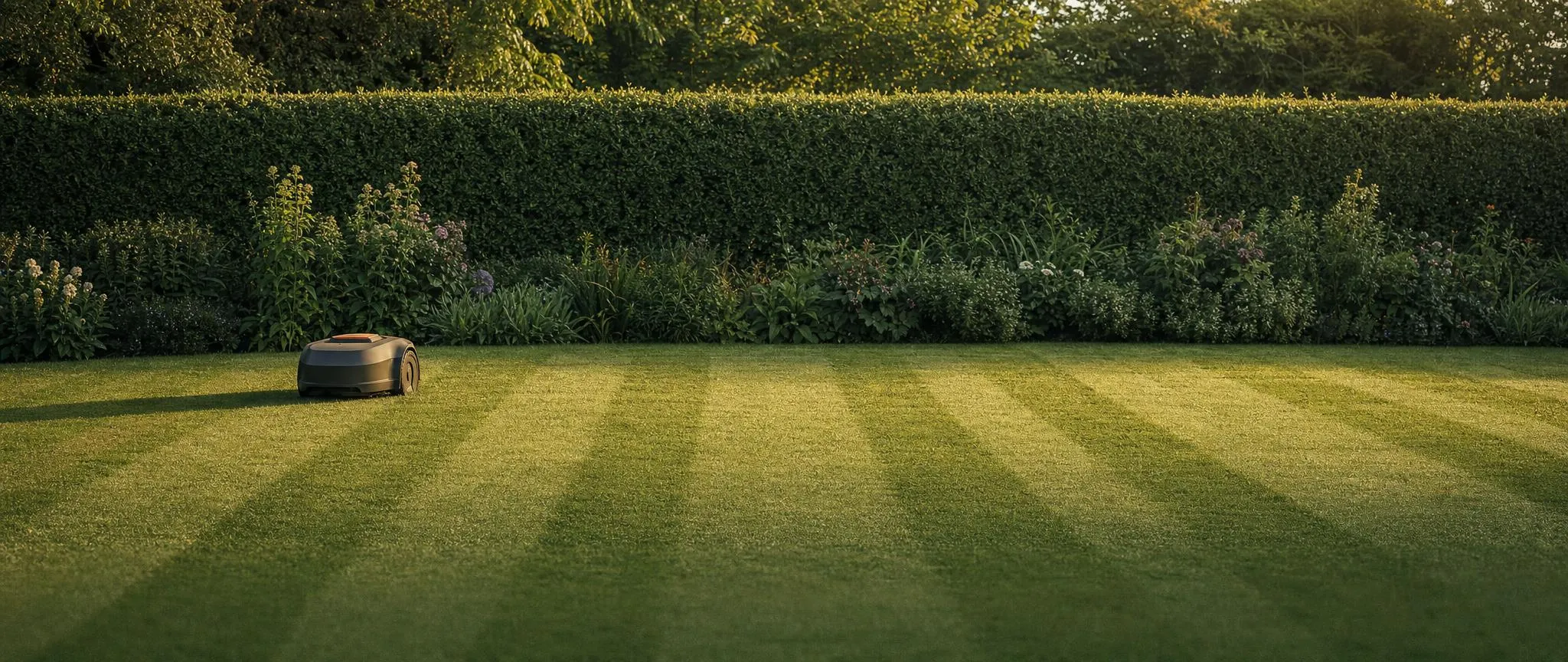

GOAT A2500 RTK
It is rated for a lawn of 0.62 acre2,500 m². It uses satellites to work out where the lawn ends, helped by a small antenna you mount on a pole. It needs a clear view of the sky, and it is much quieter than the LUBA 3.
- Quieter of the pair at 60 decibels
- Cuts as short as 1.2 in30 mm
- The antenna needs a clear view of sky
- Climbs only 50 ft50 m of rise per 100 ft100 m
LUBA 3 AWD 3000
It works out where it is over your Wi-Fi or a cell signal, so there is no antenna to mount. It also has a laser scanner that looks at the ground. It drives all four wheels, and climbs 80 ft80 m of rise per 100 ft100 m.
- Climbs 80 ft80 m of rise per 100 ft100 m
- No antenna, and it keeps working under trees
- 70 decibels, loud enough to hear indoors
- Cannot cut shorter than 2.2 in55 mm
The two mowers, side by side
| What we are comparing | ECOVACS GOAT A2500 RTK | Mammotion LUBA 3 AWD 3000 |
|---|---|---|
| How it knows where to go | Satellites and a camera. No wire to lay. | A laser, satellites and two cameras. No wire to lay. |
| Biggest lawn it can keep cut | 0.62 acres2,500 m² | 0.74 acres3,000 m² |
| Can remember more than one lawn | Yes | Yes |
| How it gets around things in its way | Camera, a sensor that measures how far away things are, a bumper it nudges things with | A laser that measures what is around it, two cameras, a bumper it nudges things with |
| No boundary wire to lay | Yes | Yes |
| Lawn it is rated for | 0.62 acre2,500 m² | 0.74 acre3,000 m² |
| Steepest ground it can climb | 50 ft50 m of rise per 100 ft100 m | 80 ft80 m of rise per 100 ft100 m |
| Powered wheels | Two | All four |
| How it knows where the lawn ends | Satellites, plus an antenna you mount | Your home internet, plus a laser scanner |
| Needs a clear view of the sky | Yes | No |
| Width it cuts on each pass | 13 in33 cm | 16 in40 cm |
| Grass height it can cut to | 1.2 in3 cm to 3.5 in9 cm | 2.2 in6 cm to 3.9 in10 cm |
| Loudness | 60 decibels | 70 decibels |
| How it spots things in the way | Camera, distance sensor, bumper | Laser scanner, camera, bumper |
How each one knows where it is
Neither mower needs a wire buried around the lawn. Both use satellites to work out where they are. A plain satellite position is off by several feet. Both mowers add extra information to bring that down to an inch or two. That is accurate enough to mow right up to the edge of a flower bed. They get that extra information in different ways.
The A2500 comes with a small antenna on a pole. You mount it somewhere with a clear view of the sky and run power to it. The antenna never moves, so it knows its own exact spot. It reads the same satellites the mower reads. It works out how far off the satellite position is at that moment. It sends that difference to the mower, and the mower corrects its own position. Most mowers that need no buried wire use this pole antenna method, and it works well. It has one limitation. Both the antenna and the mower need a clear view of the sky.
The LUBA 3 gets the same information over your Wi-Fi or a cell signal instead. There is no antenna to mount on a pole. It also carries a laser scanner that measures the shape of the ground around it. That works the same whether the sky is clear or blocked by trees.
What happens under trees
If your lawn is open, mounting the A2500’s antenna takes one afternoon. After that you never touch it again. Find a spot with a clear view of the sky, run power to it, and leave it there.
If a big tree or a tall wall shades part of the lawn, the A2500 will keep having trouble there. It loses the satellite signal in the shade and stops. So go to the shadiest part of your lawn first. Kneel down and put your head about a foot above the grass, because that is how tall the mower is. Look up and see how much open sky is left.
How steep can each one go?
- 50ft50m
- Steepest rise the A2500 climbs, per 100 ft forwardSteepest rise the A2500 climbs, per 100 m forward
- 80ft80m
- Steepest rise the LUBA 3 climbs, per 100 ft forwardSteepest rise the LUBA 3 climbs, per 100 m forward
- 15%
- What we knock off both numbers, because slope specs come from dry grass
ECOVACS says the A2500 climbs ground rising 50 ft50 m for every 100 ft100 m forward. Mammotion says the LUBA 3 climbs 80 ft24 m per 100, which is an angle of 38.6 degrees. The wheels explain most of that difference. The A2500 drives two of them. The LUBA 3 drives all four.
Slope ratings come from dry grass, so take 15% off both numbers to allow for wet grass. Treat the A2500 as good for ground rising up to 42 ft13 m per 100. Treat the LUBA 3 as good for ground rising up to 68 ft68 m per 100 ft100 m forward. Most back yards are not steep enough for either limit to matter. If any part of your yard rises more than 42 ft42 m per 100 ft100 m forward, only the LUBA 3 will do.
How big a lawn does each cover?
The two are rated for similar lawn sizes, even though one costs far more. ECOVACS rates the A2500 at 0.62 acre2,500 m² and Mammotion rates this LUBA 3 at 0.74 acre3,000 m². Both figures assume one plain, open piece of grass. Expect less if your lawn has flower beds, paths, or sits in two separate areas.
The LUBA 3 cuts a wider strip on each pass: 16 in40 cm against 13 in33 cm. Cutting a wider strip means fewer passes. On a big lawn, fewer passes means it finishes sooner. It also means the heavy mower drives over your grass fewer times, so it leaves fewer wheel marks.
Check how short each one can cut before you decide. The A2500 goes down to 1.2 in30 mm. This version of the LUBA 3 sits higher off the ground, so it cannot cut shorter than 2.2 in55 mm. If you like your grass cut shorter than 2.2 in6 cm, the LUBA 3 will not work for you.
Noise, and where each one will run
The two differ in noise. ECOVACS rates the A2500 at 60 decibels and Mammotion rates the LUBA 3 at 70. A 10-decibel difference means the LUBA 3 sounds about twice as loud.
If the mower will run in the evening beside a bedroom window, the noise rating matters most. If it runs at the far end of a big yard in the afternoon, it will not bother you.
Which one to buy
Buy the A2500 RTK if your lawn is open, gently sloping, kept short, and close to the house. It handles nearly as much grass, it is much quieter, and it cuts shorter. On an open lawn the antenna is easy to set up.
Buy the LUBA 3 AWD if your lawn has trees over it. Buy it too if your lawn has a slope steep enough that walking down it feels risky. It costs a lot more. But it keeps cutting when trees or a wall block the sky, and it climbs steeper ground.
If you are not sure which describes your yard, use our yard finder. Type your address and draw around your lawn on the satellite photo. It works out how steep your lawn is, and how much of it the trees shade. Then it tells you which of these two can handle it.