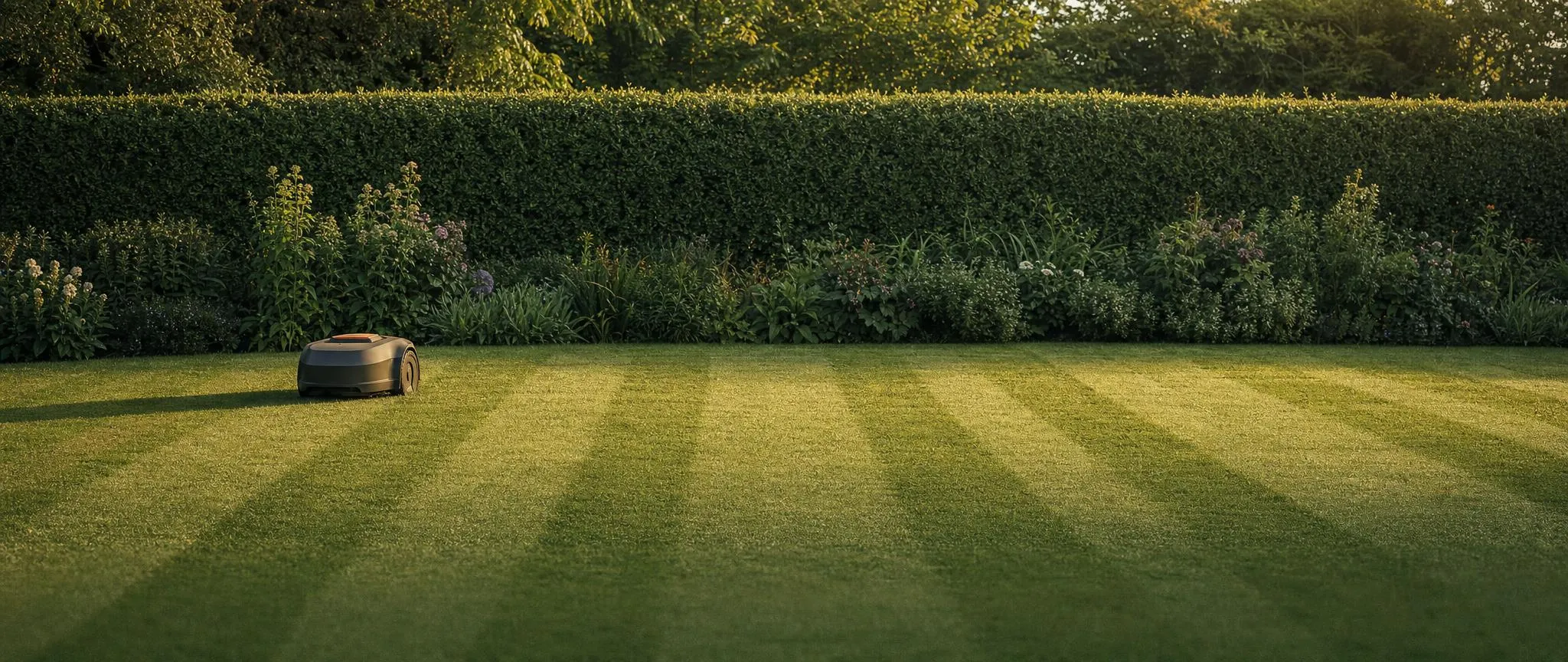

How a wire-free mower knows where it is
The satellite chip in your phone or your car can tell where you are, but it can be several feet off. On a lawn, several feet is enough to drive the mower off the grass and into your flower bed.
The fix is something called RTK. RTK adds a second satellite chip. This one sits in a fixed spot in your yard and never moves. It works out its own spot once, when you set it up. After that it always knows exactly where it is. So if the satellite signal is wrong, the fixed chip can measure how big that error is right now.
The mower is within about a hundred feet of the fixed chip. Because they are so close together, the satellite signal has about the same error at both. The fixed chip sends the mower a message telling it how far to adjust. The mower gets that message and adjusts. Now it knows its own spot to about an inch.
Land surveyors use the same method. The US government keeps fixed chips like this all over the country for them to use. The US government says this method gives a position accurate to about an inch.
Because it knows its spot to about an inch, the mower can work without a cable in the ground. You draw the edge of your lawn once in a phone app. Or you steer the mower around the edge yourself and it remembers the shape. From then on, the mower stays inside that shape. You never have to dig a channel and lay a cable. You also never have to repair a cable that a shovel cuts later on.
RTK only tells the mower its position. It cannot tell the mower what is lying on the grass in front of it. Other parts do that: a bumper on the front, cameras, and a spinning laser scanner called lidar. Some mowers also send out sound and listen for the echo.
The three kinds you can buy
| Pole in your yard | Over your internet | Laser scanner | |
|---|---|---|---|
| What you install | A pole where nothing blocks the sky, with a power cable out to it | Nothing outside | Nothing outside |
| Needs to see the sky | Yes, above the pole and above the grass | Yes, above the grass | No |
| Needs Wi-Fi or a cell signal | No | Yes, all the time | Only for the app |
| Costs you later | Nothing | A data plan, once the free period ends | Nothing |
| Has trouble with | Roof edges, trees, tall walls | Places your cell signal drops out | The dark, and heavy rain |
| Best for | Open yards, and it costs least | Open yards, with no pole to put up | Yards under trees |
A pole you put up in the yard
This is the oldest kind, and still the most common. In the box you get a small unit that stays in one spot in your yard. That is the fixed chip described above. You mount it on a pole, with a small aerial on top, and put the pole somewhere nothing blocks the sky. It sends the mower its corrections by radio, so you do not need internet for it.
Mowers that work this way usually cost the least. The ECOVACS GOAT A2500 RTK comes with the fixed unit, two poles, and a peg for holding a pole in the ground. There is a 33 ft10 m power cable in the box. That is how far the pole can sit from an outdoor outlet. Pick a spot, run the cable out to it, and leave the pole there for good.
The pole has to go where nothing blocks the view upward. That spot is often out in the open, so you will see the pole from the house. Do not bolt the unit to the house wall just under the edge of the roof. The roof then blocks about half the sky above the unit, and the unit cannot get a good enough signal to work. The spot with a clear view of the sky is often about twenty feet from the house wall. Mower brands sell long cables and extra brackets so you can put the pole that far from the house.
The kind that works over your internet
This kind needs no pole at all. Governments and land-measuring companies have run fixed units like this across the country for years. Those units send out the same kind of correction as a pole in your own yard would. Your mower picks the corrections up over your home Wi-Fi or a cell signal.
Husqvarna calls its version EPOS. Mammotion calls its version iNavi, and the LUBA 3 mower can use it. Where iNavi reaches your address, you do not have to put up a pole or run a cable out to it. Putting up the pole and running that cable is the hardest part of setting up a satellite mower.
This kind has two limits. First, the brand’s service has to reach your address. The service covers most towns and cities. In the country it often does not reach, or works only some of the time. Second, the mower still has to pick up the satellites itself. The corrections only adjust a satellite signal the mower already receives. If trees block the satellite signal, the corrections cannot fix it.
Mowers that skip satellites entirely
The third kind does not use satellites at all. It has a small spinning laser on top. The laser measures how far away the fence, the house and the trees are, all the way around. From those measurements the mower draws its own map of your yard. Cameras on the front watch for where the grass stops. The eufy E15 and E18 work this way. So do the ECOVACS LiDAR PRO models and the Mammotion LUBA mini 2.
Buy this kind if trees shade your yard. It does not use satellites, so nothing on it needs a clear view of the sky. But it is new. It only works on smaller lawns, and it does worst on wide, flat, empty ground. On that kind of ground the laser has no fence or wall nearby to measure. So the mower loses track of where it is. A big open two-acre lawn needs the satellite kind.
What stops it working
Three things block the satellite signal. In each case something solid sits between the grass and the sky.
- Trees overhead. Leaves let some of the signal through, but they make it weak. The mower keeps mowing, but it no longer knows its exact position. It veers off, comes back, leaves a wavy cut line, and every so often stops and reports an error.
- The roof, including the edge that hangs out past the wall. It blocks a whole section of sky at once. Tall fences do the same, and so does any two-story wall next to the grass.
- A tall wall on the south side. These satellites never fly over the far north or far south of the Earth. So across the mainland United States, most of them sit in the southern half of the sky. If the lawn is on the north side of a tall house, the wall blocks most of those satellites.
Check your yard in summer, when the trees are in full leaf. A tree with bare branches in March lets the signal through. The same tree can block the signal in June, once its leaves are out.
Look at where shade falls on the lawn to find any of these three things. If a patch of lawn is in shade most of the day, something is blocking the sun there. That same thing blocks the satellite signal. Shade does not show every blockage. Look straight up from the shaded spots, and from any spot next to a tall wall.
How to check your yard before you buy
Start by checking your address online. Segway Navimow has a page for its X3 mower. Type in your zip code and it tells you whether the internet version works where you live. Husqvarna has the same thing for EPOS. Both tell you clearly if your area is out of range. If it is, buy a mower that comes with its own pole instead. Check both pages before you choose a model.
Then walk the lawn and look up. Stand in the corner with the most trees, roof or wall over it, and check any other spot with something above it. Crouch down to about a foot above the grass, because that is how tall the mower is. From there, see how much of the sky is still open. Check in summer, when the trees are in full leaf. Then look for a place to put the pole where nothing blocks the sky. Make sure you can run a power cable to that spot.
Our yard finder gives you a quick first answer from a satellite photo of your address. It uses free government maps to work out how big your lawn is, how steep, and how many trees hang over it. Each brand says how big and how steep a lawn its mower can handle. We take a safety margin off each of those limits first. Then we see which mowers still fit. We are only comparing published numbers, so treat the result as a starting list.
When a cable is the better buy
Blocked satellite signals do not affect the older cable kind. You lay a cable in a ring around the edge of the lawn. Pin it on top of the grass, or bury it just under. The mower senses the cable and turns around when it reaches it. Trees, roofs, walls and clouds make no difference at all. Buy this kind if your yard has a lot of trees over it.
It also costs a lot less to cover the same size lawn. Some brands sell the same mower both ways, one with a cable and one with satellites. The satellite version costs much more. Both versions can mow slopes of the same steepness. The satellite kind saves you the work of laying the cable. Both kinds cut the grass equally well. Our A2500 and LUBA 3 comparison shows when the extra cost is worth it.
Buy the cable kind if your lawn has trees over it, is big, and is one plain open area. Buy it too if you want to set the mower up once and never think about it again. Do not buy it if flower beds and paths break your lawn into several odd-shaped pieces. Skip it as well if you often move your beds around, or if tree roots and rocks make digging hard.