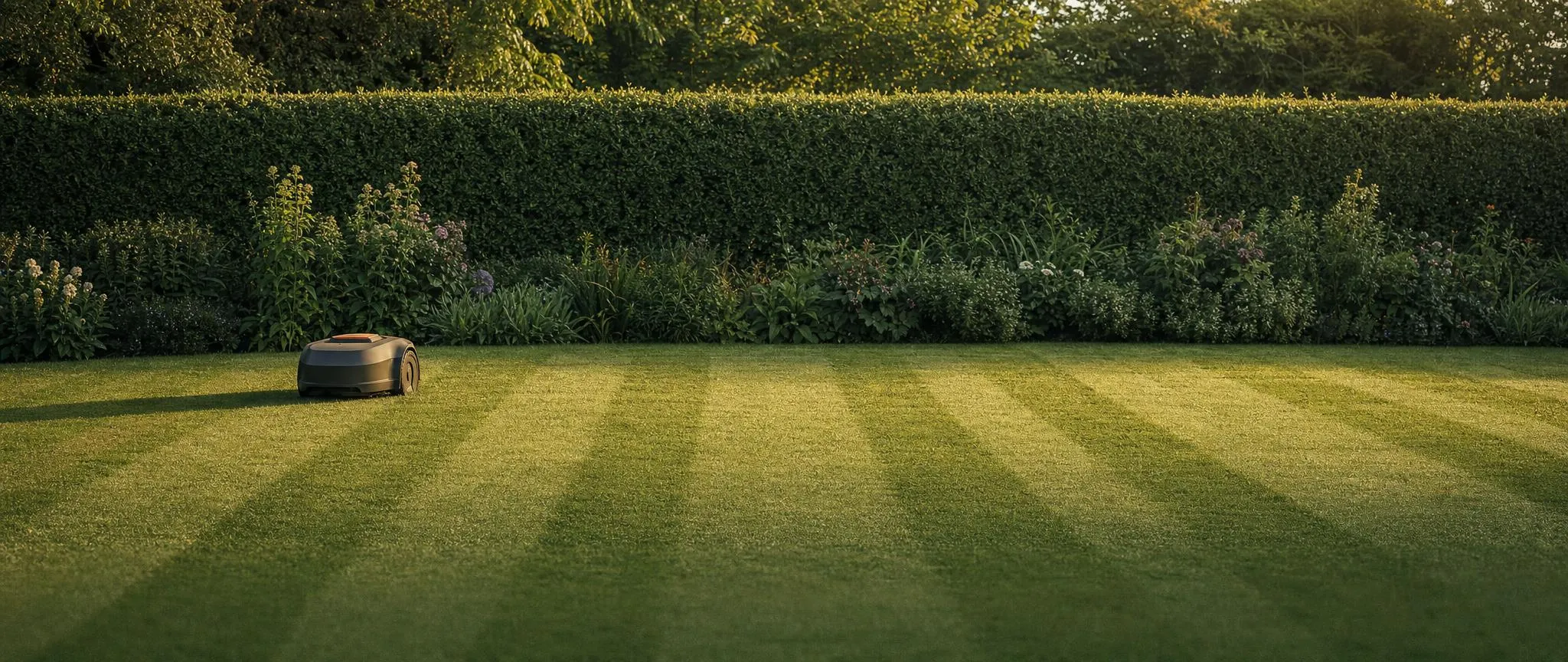

- Maps with a laser and a camera, so trees and shade don't stop it
- Cuts up to about three-quarters of an acre from one base
- Spots a hose, a toy or a flower bed and drives around it
- Costs two and a half times as much as the cheapest robot mowers we review
- No built-in cellular signal; ECOVACS sells an add-on for that
- The trimmer that edges the lawn is loud
The brand's numbers
- How it knows where to go
- A laser and a camera. No wire, no satellites.
- Biggest lawn it can keep cut
- 0.74 acres3,000 m²
- Steepest hill it can climb
- 50% — a rise of 50 ft per 100 ft (about 27°)
- Cutting width
- 33 cm (13 in)
- Cut height
- 30–90 mm (1.2–3.5 in)
- Can remember more than one lawn
- Yes
- How it gets around things in its way
- A laser that measures what is around it, Camera, a bumper it nudges things with
- No boundary wire to lay
- Yes
- Needs open sky over the lawn
- No
- Connectivity
- bluetooth, wifi
- Loudness
- 62 decibels
- Price checked on
- September 2026
The rated lawn area is how much grass the brand says this mower can keep cut. It mows, returns to its charging base to recharge, then goes back out to mow again. A lawn bigger than the rated area will not damage the mower. It cannot reach every part of the lawn often enough, so grass at the far end grows too tall between cuts. Brands rate each mower for the steepest ground it can handle. Do not go past that rating. On ground steeper than that, the mower can slip.
Use our Yard Finder to find the best robot mowers for your exact yard Trace your lawn. We read its size, slope and tree cover off the map, then show you the mowers that clear those numbers.Who is the A3000 LiDAR PRO for?
Buy this for a big yard with trees over parts of it. A wire-free mower does not need a wire buried around the lawn edge. Most of them only work with open sky overhead. Tree branches block the satellite signal, and the mower stops. The A3000 LiDAR PRO works a different way. It works out where it is with a spinning laser and a camera, so shade does not stop it.
It is not the right buy for a small lawn. On a quarter-acre yard you would pay for cutting area you never use. It is also not a budget pick. It costs about two and a half times as much as the cheapest robot mowers we review. For a small or shady lawn, the eufy E15 handles shade and costs far less.
How does it find your lawn without satellites?
Most wire-free mowers work out where they are from satellite signals, the way your phone does for maps. That needs open sky. A tall tree or a roof blocks the signal, and the mower stops. The A3000 LiDAR PRO does not use satellites. A laser scanner spins on its lid. It sends out pulses of light and times how long each one takes to bounce back. From those times it builds a map of what surrounds it: the fence, the shed, the trees, the beds. A camera helps it spot things in the way, like a hose or a ball. It can store maps for more than one lawn, such as a front yard and a back yard.
This method has a name: lidar, short for light detection and ranging. NOAA’s explainer calls it a laser that measures distance by timing a pulse of light. Scientists use it to map coastlines and forests. On this mower, the same kind of laser maps your yard.
Because it never needs a clear sky, heavy tree cover does not stop it. That is why it suits a yard with heavy tree cover better than a satellite mower does. Our satellite-mower guide explains that kind in full.
How steep a slope does ECOVACS rate it for?
- 50ft50m
- Rise per 100 ft forward, from the ECOVACS spec tableRise per 100 m forward, from the ECOVACS spec table
- 42ft42m
- Rise per 100 ft forward, once you allow for wet grassRise per 100 m forward, once you allow for wet grass
- 20ft20m
- Rise per 100 ft forward, along the edge of the lawnRise per 100 m forward, along the edge of the lawn
ECOVACS gives two answers to that question on the same page. The spec table says a rise of 50 ft50 m for every 100 ft100 m forward, which is 27 degrees. Higher up that page, the sales copy says it handles hills of up to 15 degrees. Written the same way, 15 degrees is a rise of about 27 ft27 m per 100 ft100 m. That is close to half of what the table says. The page does not say which one applies where.
We use the spec table figure, and so does our yard finder. Slope ratings come from dry grass, and dew or rain makes grass slick. So the finder takes about 15% off the rated slope before it says a mower fits. For this mower, that leaves a rise of 42 ft42 m per 100 ft100 m. If your lawn is often wet when it mows, plan for a rise of no more than 42 ft42 m per 100 ft100 m forward.
The manual adds a third slope figure, and it is the lowest of the three. When you set the mower up, you drive it around the lawn edge to draw the map. ECOVACS tells you not to draw that edge on a slope steeper than a rise of 20 ft20 m per 100 ft100 m. The mower cuts the strip along the edge by driving across the hill, and it turns at each end. A wheel can slip when the mower turns on a hill.
What are the drawbacks at this price?
This is the top model in the ECOVACS range, and it costs more than any other ECOVACS mower we review. Check a few more things before you buy.
It trims the edges with a small string cutter, the kind on a hand tool. The mower body runs about 62 dB, no louder than talking. The trimmer is louder than the mower body. It runs near 82 dB, about as loud as a vacuum cleaner. Run it early and a neighbor will hear it. Schedule it to run in the middle of the day.
Theft protection is a PIN code and a lift sensor. The manual says the PIN locks the mower in two cases. Someone carries it outside the lawn area you mapped, or someone restarts it. The spec table lists a lift sensor, and picking the mower up sets off an alert on your phone. That alert travels over your home Wi-Fi only. The mower has no cellular signal of its own, the kind a phone uses. Carry it out of Wi-Fi range and the app can no longer reach it. ECOVACS sells a paid cellular add-on. The page for that add-on says only that it works with this mower. The manual adds one detail: the add-on takes a SIM card. ECOVACS has not said what the add-on does.
Is it worth it?
For a big yard with trees over it, yes, it is worth it. A cheaper satellite mower loses its signal under branches, so it stops and leaves uncut patches. This one still works out its position, because its laser scans the trees and uses them as reference points. You also get the trimmer and one map for several lawns.
You have two things left to check. One is the width of your narrowest gate, which must be more than 35 in89 cm. The other is how much of your grass sits on a slope steeper than a rise of 20 ft20 m per 100 ft100 m. If your narrowest gate is wider than 35 in89 cm, and only a small part of your yard is that steep, buy it. If either check fails, choose a mower built for that yard.